

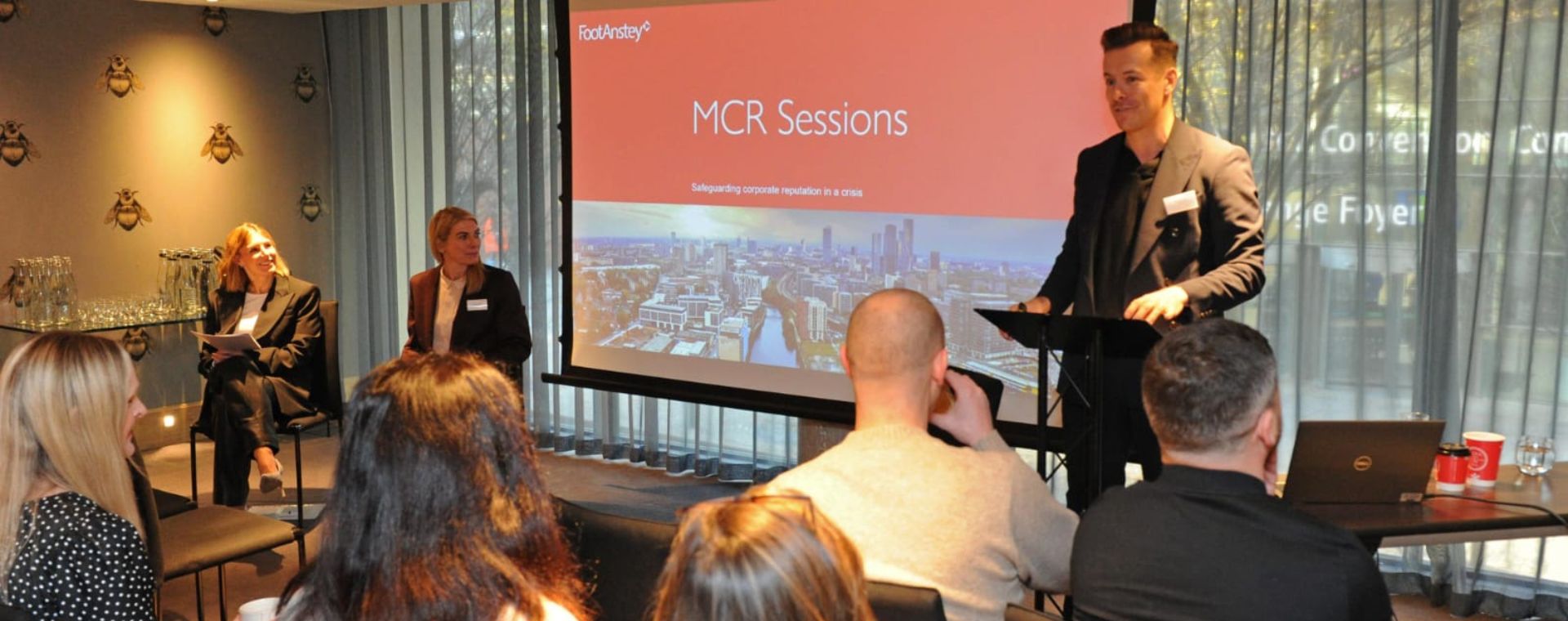
Safeguarding corporate reputation in a crisis: MCR Sessions event by Foot Anstey in Manchester
Sugar PR had the pleasure of attending “MCR Sessions: Safeguarding Corporate Reputation in a Crisis” – an insightful and expertly curated event hosted by our client national law firm Foot Anstey in Manchester.
The session brought together in-house lawyers, communications professionals and industry leaders to explore one of the most pressing issues facing organisations today: how to protect corporate reputation in a fast-moving, high-stakes environment.
A venue steeped in Manchester music history
Adding to the atmosphere was the venue itself: The Edwardian Manchester, formerly the iconic Free Trade Hall. Long before it was home to legal and communications insight sessions, its stage witnessed the legendary 1976 Sex Pistols gig –the spark that ignited a cultural revolution across Manchester. That night went on to inspire a wave of talent including Joy Division, The Smiths, Buzzcocks, The Fall, Morrissey and Mick Hucknall.
Standing in a room where artistic disruption once reshaped British music felt like the perfect backdrop for a conversation about corporate disruption, reinvention and the importance of shaping your own narrative. Just as that gig helped launch an entirely new creative movement, Foot Anstey’s event reminded us how pivotal a single moment can be in defining – or redefining – an organisation’s reputation.
Legal, PR and marketing teams: ‘Stronger Together’
One of the strongest themes of the morning was the evolving relationship between lawyers and communications professionals. What used to be two separate disciplines is now a shared responsibility – especially in an environment where legal risk and public sentiment move at very different speeds.
Manchester-based Foot Anstey partners Tom Kershaw and Melanie McGuirk highlighted the need for mutual understanding, clear processes and rapid alignment. A response that is legally sound but poorly communicated may inflame a situation, while a communications-first approach that overlooks legal constraints can expose organisations to risk.
Adding additional depth was Louise Winmill of THREESIXTY, who provided a powerful reminder of how public mood, audience sentiment and message credibility shape outcomes. Louise emphasised that organisations must listen as actively as they speak — and that authenticity, tone and timing can be as important as the content itself when trust is under pressure.
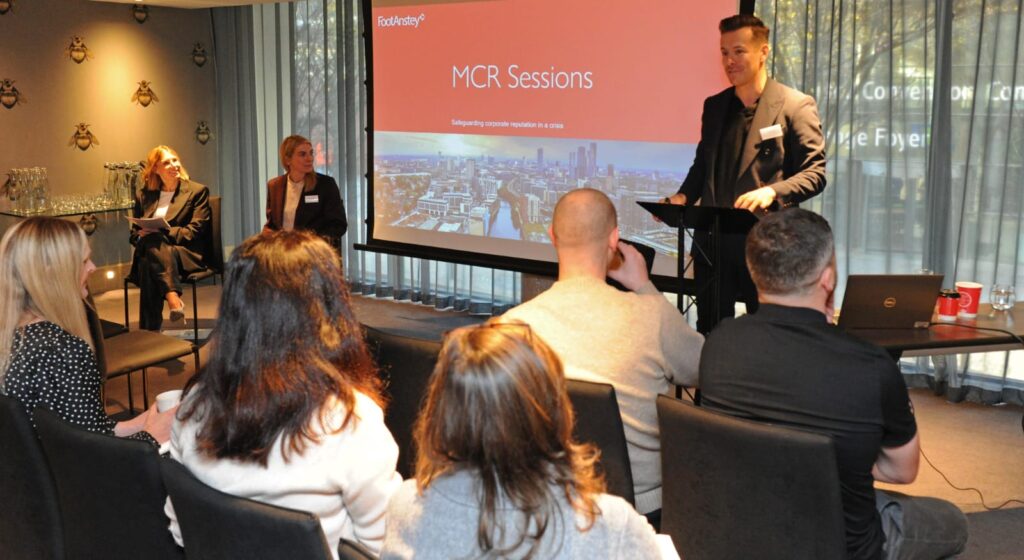
Tom Kershaw introduces the MCR Sessions to a packed room in Manchester hosted by Foot Anstey
AI is the new accelerator of crisis – and an opportunity to respond better
A theme that resonated strongly throughout the discussion, and one we at Sugar PR see daily, is the rising influence of artificial intelligence in shaping reputation.
AI now sits at the centre of how information is created, shared and interpreted:
- Negative stories can spread faster than ever as algorithms amplify emotionally charged content.
- AI-generated misinformation and deepfakes can escalate a crisis before a brand is even aware.
- Automated commentary and bot-driven narratives can distort the early public response.
- Positive stories or clarifications can be boosted when organisations strategically use AI tools to monitor, analyse and respond.
This dual nature of AI — as both a threat and an opportunity — makes it essential for businesses in 2026 to have a defined AI strategy as part of their crisis plan.
This strategy must include:
- AI monitoring tools to track sentiment and detect emerging issues in real time
- Protocols for identifying and addressing deepfakes or misinformation
- Clear guidelines for AI-generated statements or content
- Training for senior teams on how AI influences public perception
- Scenario planning that incorporates AI-driven escalation models
In short: the organisations most likely to recover well from future crises will be those that treat AI not as a novelty, but as a core part of their communications and legal preparedness.
Crisis response in 2026
The session explored the intensity, speed and unpredictability of modern reputational risks. News cycles are shorter, scrutiny is higher, and stakeholders expect immediate transparency. The margin for error is shrinking.
Key insights included:
- Preparedness must be proactive. Crises unfold too quickly for on-the-spot improvisation.
- Employees are frontline communicators. Internal alignment matters as much as external clarity.
- Trust is the defining currency of modern business. Those who act openly and swiftly retain reputation strength.
- AI is now a central pillar of crisis escalation — and crisis response.
The conversation dovetailed perfectly with what Sugar PR sees across our client base: organisations that anticipate reputational risks and embrace technology will outperform those that rely on outdated crisis playbooks.
A word from Sugar PR
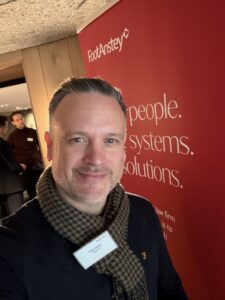
Pete Davies at the MCR Sessions ‘Corporate Reputation in a Crisis’ event hosted by Foot Anstey in Manchester
Reflecting on the event, Pete Davies, founder of Sugar PR in Manchester, said:
“Foot Anstey delivered a first-class session that was both thought-provoking and genuinely useful. The insights on how legal and communications teams can work together during high-pressure moments were invaluable.
“The growing role of AI in modern crises was a timely reminder that organisations need to be preparing now. We’re looking forward to more Manchester-based events from Foot Anstey – they’re exactly the kind of conversations organisations must be having in 2026.”
Looking ahead: the future of reputation in 2026 and beyond
With AI accelerating narratives, regulation tightening, and stakeholder expectations rising, reputation is no longer a PR afterthought — it’s a board-level priority.
Businesses that succeed in 2026 will be those that:
- embed reputation thinking into every strategic decision
- integrate AI into crisis preparedness
- embrace transparency, even when uncomfortable
- build strong legal–communications partnerships
- stay proactive instead of reactive
Sugar PR remains committed to helping organisations stay ahead of these challenges – offering clarity, calmness and strategic thinking when it matters most.
A huge thank-you to Foot Anstey for hosting such an engaging and relevant session. We’re already looking forward to the next one and to continuing the conversation around how businesses can safeguard their most valuable asset: their reputation.